For the Wild Birds Unlimited APS squirrel baffle, the published guidance places the top 4½ to 5 ft (about 1.37 to 1.52 m) above ground. Use your own model’s measurement point: a coupler, rim and bottom edge can all sit at different heights. In a snowy yard, check the distance from the packed surface a squirrel can stand on. The entire feeder and tray must remain beyond reach above the barrier. If a squirrel arrives from a nearby fence, changing vertical height on the pole will accomplish little.
Identify which height your directions describe
Lay the uninstalled baffle beside the pole and find the supplied bracket or coupler in the drawing. Does the instruction describe the height at the top of the assembled baffle, the support on the pole or a particular rim? Hold the empty baffle in its installed orientation according to the drawing and measure the vertical offset between those points. Two parts that touch need not be at the same height once the shell rests on the collar.
Compare the wording from two sources. The APS guidance names the top. WoodLink’s two-piece torpedo description says to mount it below the feeder at about 4 to 5 ft (1.2 to 1.5 m) above ground using the included coupler. The short product description does not name a top or bottom reference as precisely as the APS guidance does. Use the instructions supplied with the WoodLink unit or ask the maker about the reference point. Do not import a precise edge from a different design to fill in a missing detail.
An instruction for a long raccoon cylinder can name another edge and a different animal. If nighttime damage or camera evidence points to a raccoon, use the raccoon baffle height and size guide. If you are hanging a dome above a suspended feeder, this pole calculation also does not apply. The starting approach, support and relationship of the barrier to the food are different.
Establish where the squirrel can stand
Measure upwards from the highest firm approach beside the pole. On level summer turf that may be the same as the soil line. In February it may be the top of a packed bank pushed against the station when the path was cleared. A retaining wall, planter edge or box at the same level can act as a raised starting point. Take note of whether the approach touches the pole or lets a squirrel reach the feeder from the side.
A tape lying along sloping ground measures a different distance from the vertical rise to the baffle. Stand it vertically at the relevant approach and record the height to the specified edge. Check the uphill side as well as the spot where you normally refill. A garden border can look low from the downhill viewpoint while leaving little rise on the opposite side. If the nearest elevated object is also an easy sideways launch, treat it as a clearance problem and consider moving the station.
| Number to record | Where to measure | What it tells you |
|---|---|---|
| Bare-ground reference | Firm ground to the maker’s named baffle point | Whether the original installation matches the model guidance |
| Raised approach | Bare ground to packed snow, wall top or other usable surface | How much effective vertical clearance has been lost |
| Lowest accessible food | Same approach to tray, bottom port or other reachable edge | Whether an animal can take seed without climbing past the baffle |
| Service height | Cleared standing spot to hook release | Whether you can still remove the feeder safely after an adjustment |
Work through one winter example
Suppose the top of the APS baffle is 60 in (152 cm) above bare ground. A packed snowbank rises 12 in (30 cm) at the pole. The effective height to the top is now 48 in, about 122 cm. Compare that result with the maker’s 54 to 60 in guidance. The baffle can look unchanged from the window while the upper edge has effectively dropped below its intended range.
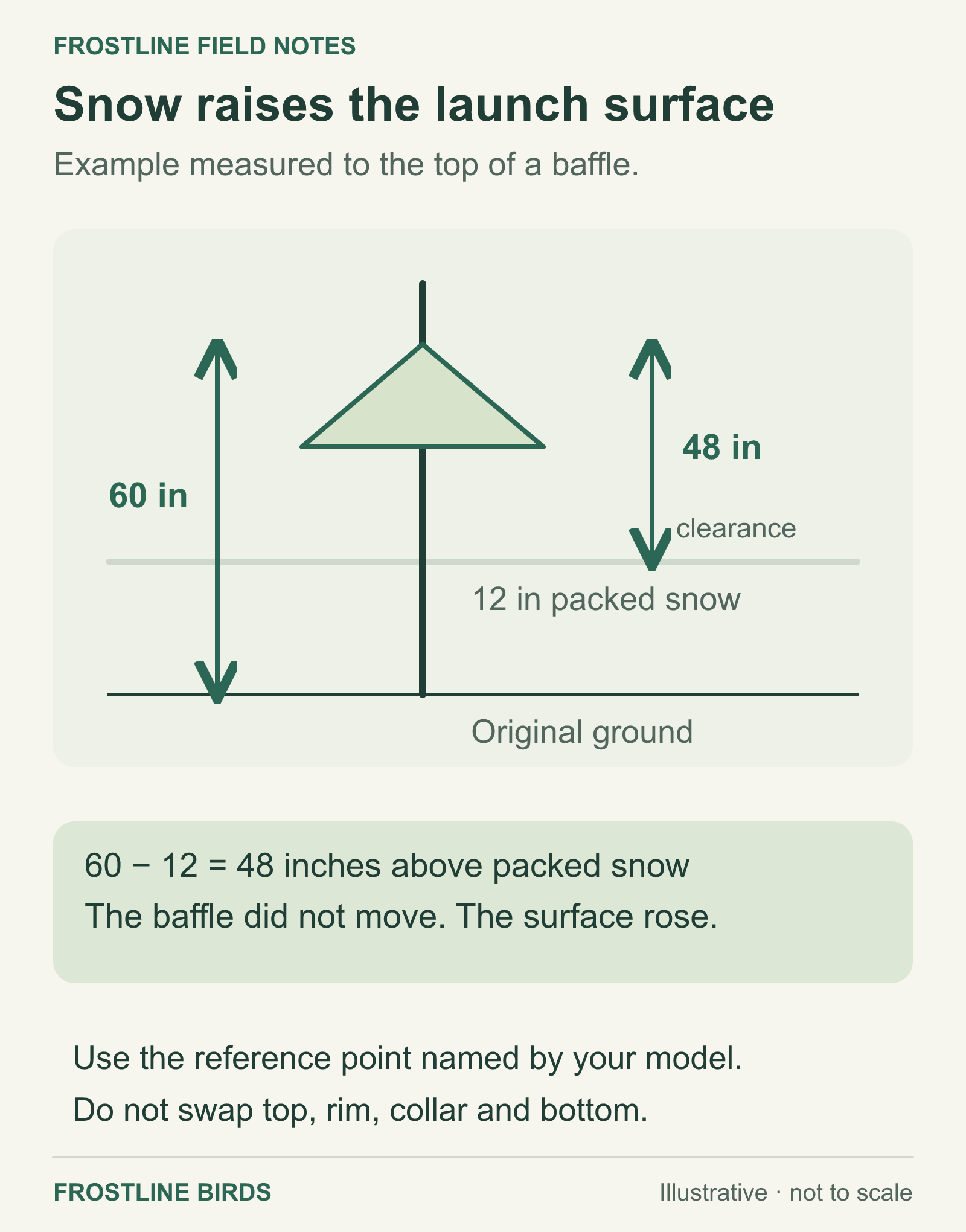
To restore an effective 54 in (137 cm) over that bank, the top would need to be about 66 in (168 cm) above bare ground, since 54 + 12 = 66. Treat that as a fit check. Look where the top, bracket and feeder would actually end up. If the raised baffle would meet a low feeder or the arm coupling, that position is unsuitable. Raising a telescoping section beyond its rated position or placing the feeder beyond safe reach creates another problem.
Often the better change is how the path is cleared. Put snow elsewhere if you can do so without blocking the path, burying shrubs or making a new launch point. If ordinary snowfall, rather than shovelling, routinely removes the entire margin, look for a lower-drift site. Reassess the new site with the tree and fence clearance guide. A site with less snow can still be bypassed from a deck.
Set the coupler with the feeders removed
Work in calm conditions from stable footing. Remove the feeders before manipulating the pole or opening a wraparound baffle. Mark the desired position of the finished reference edge on the pole, then use the model drawing and the measured offset to position the coupler. Some shells rest on a support and need room to move. Others have an attachment that must be positively engaged. Install the hardware in the configuration the maker specifies.
Once assembled, measure again to the named point. A collar placed at the intended top height may leave a shell sitting too high or too low. Check around the pole for a projecting screw, another accessory immediately below the rim or a loose joint that changes how the shell rests. Never add grease, sticky material or sharp obstacles to make up for a poor fit. If a collar slips on the pole even when installed correctly, verify the pole diameter and use the appropriate compatible hardware.
Rehang the normal feeder and look for a new route over the barrier. An added seed tray can project down beside the baffle, and a long hanger can lower the feeding surface without changing the hook height. Look from the ground, the nearest fence and the highest patch of packed snow. The first piece a squirrel could reach might be a decorative perch on the arm rather than the food port itself.
Photograph the installed coupler against an adjacent, removable reference mark. If the mark stays at the same height above bare ground while the coupler drops, you have evidence of slippage without disturbing the assembly.
Check the height against an observed visit
Watch what happens before adjusting again. Does a squirrel climb the pole, meet the shell and retreat? Does it spring straight to a tray, drop from above or travel along a fence and take seed without touching the pole? Only the first two observations tell you much about the vertical layout. A single empty feeder does not establish which animal visited or which dimension needs changing.
Mark down the date, snow level, baffle height and first point of contact. If the installation meets its dimensions but a bypass is evident, use the squirrel troubleshooting guide to correct the route. Recheck after a new feeder, a thaw or a large snowfall. Keeping the original bare-ground measurement makes each seasonal check quick and gives you a way to distinguish a slipping coupler from a rising surface.