Choose a cone or wide disk when the pole has room for its rim and the mounting kit fits the shaft. Choose a cylinder when there is less horizontal room but enough uninterrupted pole length for its body. A one-piece cylinder also needs an accessible pole end unless its instructions specify otherwise. Before choosing either, establish that the squirrel climbs the pole. Neither shape protects food that can be reached directly from a fence, roof or branch.
Measure two different kinds of space
Stand at the intended baffle height and imagine the underside of a broad umbrella around the pole. What would its edge touch? A side bracket, a nearby rail, a person’s coat on the winter path or a hanging feeder can interfere with a wide guard. Measure the shortest free distance from the pole centre to any obstruction in every direction. The width needed for a broad cone is its radius on each side of the pole, plus clearance for any movement its maker intends.
Now look up and down the shaft. A cylinder occupies less space side to side, but it needs a continuous vertical section beneath the feeding equipment. A collar, telescoping joint, lower feeder arm or auxiliary water dish can occupy that same span. Measure the available length between the baffle’s required mounting position and the next obstruction. Merely holding a cylinder beside the pole at a convenient waist height will miss a conflict at its actual working height.
Make these measurements with the filled arrangement in mind. A tube on a chain hangs lower than its supporting arm, and a sloping tray may project into a cone’s rim as it swings. Snow at the base changes the effective mounting height. The squirrel baffle height guide explains which reference point to use once you have narrowed the model choice. Decide shape and height together before tightening any hardware.
Compare two real geometries on paper
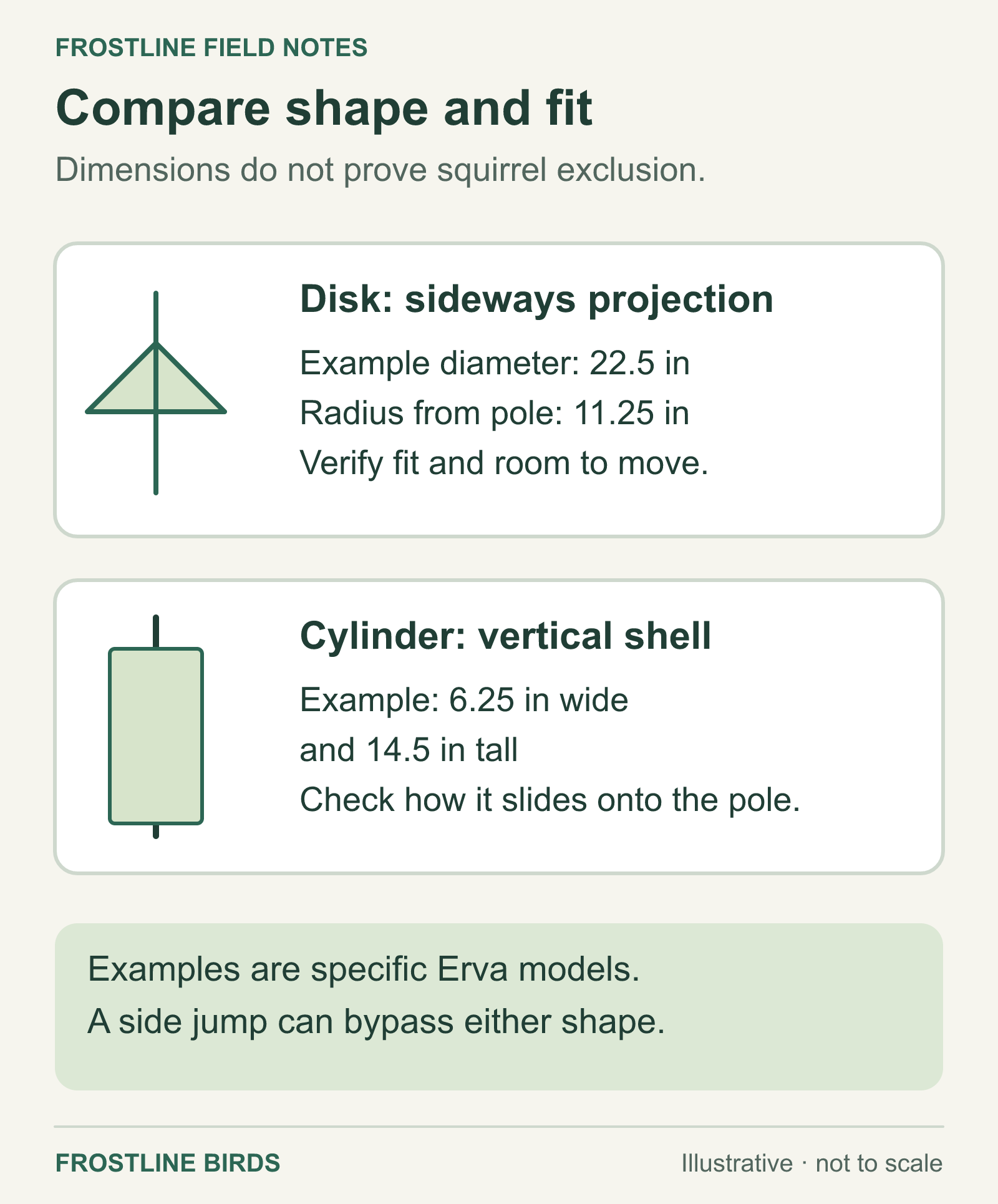
Erva’s round-pole disk is 22½ in (about 57 cm) across and accepts round poles from ½ to 1 in (about 13 to 25 mm) in diameter. That places its outer edge about 11¼ in (29 cm) from the pole centre. If a path edge or accessory is only 8 in (20 cm) from that centre, the disk already extends past it before allowing room to move. The calculation describes physical fit. It does not measure a squirrel’s reach or establish a guaranteed effective overhang.
The same maker’s round-pole cylinder listing gives the standard squirrel version a diameter of 6¼ in (about 16 cm) and a height of 14½ in (about 37 cm). The pole range on that listing runs from ½ to 1¾ in (about 13 to 44 mm). A 1¼ in (about 32 mm) round pole would fall outside the listed disk range but inside the cylinder range. That alone rules out the disk example for that pole. There are other disks and other cylinders. The shape alone does not specify the compatible shaft size.
| Feature to compare | Cone or disk | Cylinder or torpedo |
|---|---|---|
| Space requirement | Width of rim around the pole | Body length along the shaft |
| Typical obstruction to inspect | Nearby arm, rail or footpath at rim height | Joint, collar or low tray beside the body |
| Mount fit | Check centre opening and supported pole profile | Check collar range, body clearance and access to an end |
| Installation on fixed hook | Look for a model explicitly designed to open around the shaft | One-piece versions may be impossible to slide on |
| Winter check | Rim remains clear and the support works as designed | Body remains seated correctly and its vertical gap is preserved |
Check how the baffle gets onto the pole
A curved shepherd’s hook can prevent a closed collar or shell sliding down from the top. A forked foot or permanently anchored lower end can block entry from below. Erva explicitly describes the cited cylinder as a one-piece body for poles that come apart. Measure the section you plan to fit and confirm that disassembly really exposes a usable end. A pole that looks sectional may have a fixed decorative finial or a branch welded across the opening.
A split or two-piece design can solve that installation constraint if its approved coupler fits the pole. WoodLink lists a two-piece torpedo with a supplied coupler. Check the actual model instructions to see how the seam closes and how it sits once mounted. A wraparound seam that cannot fully engage because of a nearby arm is a poor fit even if the listed pole diameter matches. Do not cut a slot into a solid baffle, enlarge its centre or replace a collar with protruding hardware to force the fit.
Measure the pole’s outside diameter at the intended mounting spot. Decorative fluting, a square section or a sleeve over a narrow inner tube changes the bearing surface. A clamp sized for a round shaft might meet only the corners of a square post. If your support is square, look for documented square-post compatibility and check the actual dimensions. A product called a post baffle and another called a round-pole baffle can have the same outer shape with entirely different attachments.
Choose by the route you observed
If a squirrel climbs a clear pole and attempts to go around the existing rim, inspect that rim for damage and the bracket for a foothold. A wider compatible guard may remove that particular route if the yard has room. If the animal climbs a decorative projection below a damaged cylinder, replacing the bent support or removing the unauthorized foothold may solve more than changing the shape. Watch the point where it gets past the barrier before ordering another.
If it launches from the top of a nearby fence and lands on the food tray, remove both shapes from the immediate shopping list. Change the clearance or the station position. The baffle troubleshooting guide separates climbing from jumping, reaching and lid access. If you find heavy nighttime damage without daytime squirrel evidence, use the nighttime visitor guide before choosing a squirrel-sized cylinder for a larger animal.
If the observation is inconclusive, leave the camera aimed at the whole station, including the first landing point and the ground. A tight picture of a squirrel eating from a port shows that it reached the seed but will not tell you which baffle geometry could have stopped it.
Compare the cost of an installation you can service
List the complete parts required for each viable option: the shell, compatible support, any manufacturer-required adapter and any replacement arm needed for clearance. Check whether the listed hardware is included and whether you can detach the shell for inspection without removing a frozen anchor. A less expensive solid shell is no saving if installing it requires replacing a sound pole, while a costly split unit may add nothing on a pole that comes apart in seconds.
After fitting, remove tools and inspect the outer edges, seam and area where the baffle rests. Look for contact with nearby hardware when it moves as intended. Recheck after wet snow, after adding a tray and after changing hangers. If a broad guard affects the station’s stability, use the wind stability guide and the manufacturer’s load instructions before leaving it outside. Both shapes deserve the same final test: a correctly fitted barrier, a safely reachable feeder and no easier route around the pole.