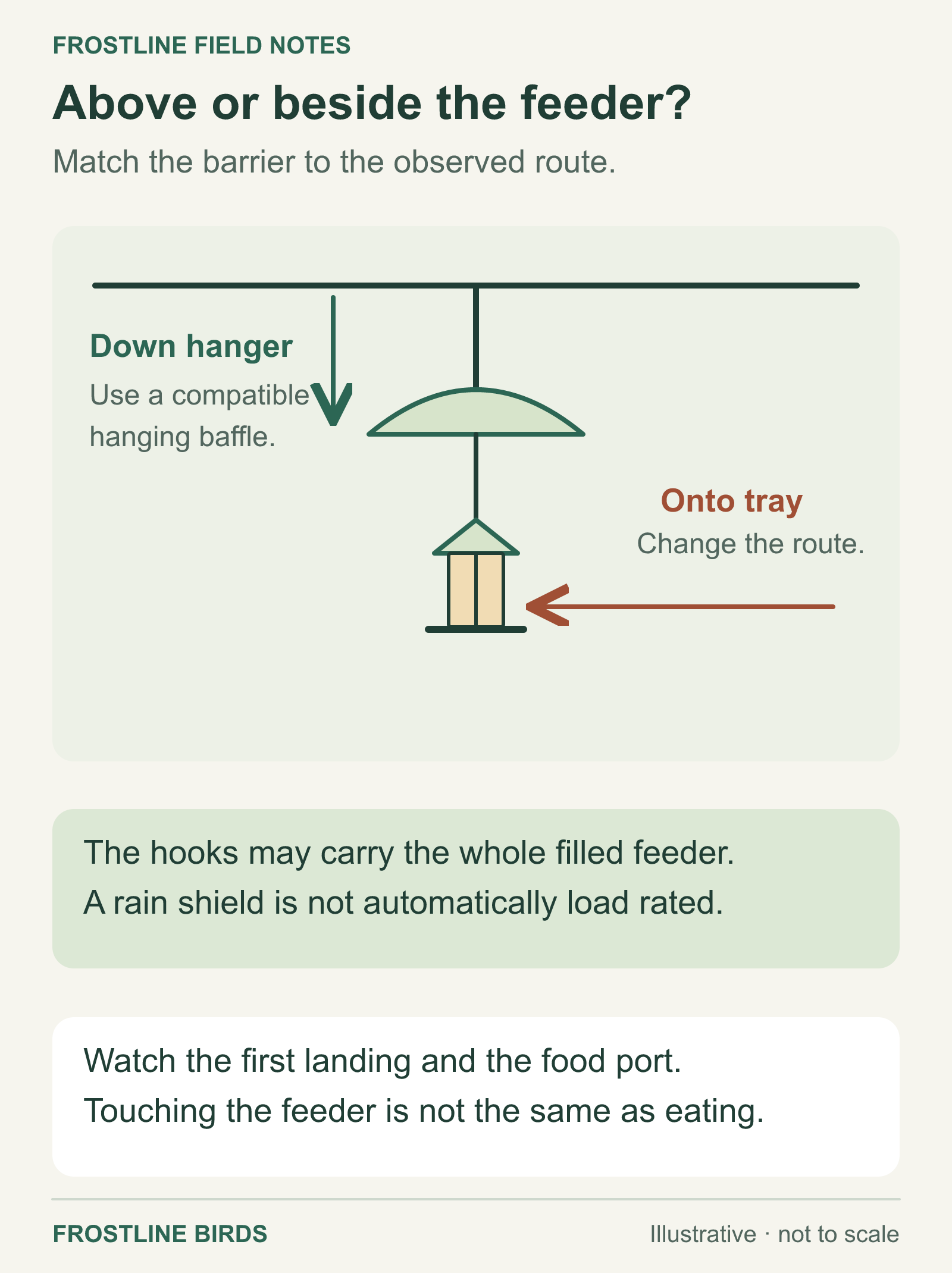
Watch how the squirrel reaches the food. For one climbing down the hanger, use a baffle designed to suspend a feeder beneath it. For one jumping directly onto the tray, change the hanging location. If a squirrel can land on the feeder regardless of location, a compatible cage or weight-activated feeder may restrict access to the seed. Choose a support that can carry the entire loaded assembly, and keep all parts reachable from stable ground. A pole baffle below the food will do little for a feeder approached from above.
Follow the hanger all the way back to its support
Look beyond the short wire loop on the lid. Follow the route up the chain, along the hook and back to the tree, deck beam or purpose-built support. A squirrel can move down from a branch, across from a shed or along an existing suspension cable. In each case, protecting just the last few centimetres above the lid may leave another landing point beside the tray. Draw the branch and nearby structures as well as the feeder.
Watch an ordinary visit from the side. Note whether the animal’s first contact is the upper hook, the outside of a dome, the upper lid or a perch near the food. If it grabs the tray first, look towards the side it came from before increasing the length of the hanger. If it arrives at the lid along the chain, a top-mounted barrier is relevant. If it stays on a trunk while feeding, a mechanism relying on the squirrel’s body weight may never activate.
| Observed route | Adjustment with a reason to work | What can still defeat it |
|---|---|---|
| Down the chain from above | Correctly installed, compatible hanging baffle between support and feeder | Side approach to the tray or lower hook |
| Across from a trunk or rail | Move the feeder away from that foothold | A different branch or roof above the new site |
| Lands directly on the feeder | Compatible cage or weight-activated feeding ports | An animal supported by a separate surface while reaching through |
| Along an existing rated suspension system | Use the system manufacturer’s compatible guard or relocate | Low sag, abrasion or an exposed end near another foothold |
| Chews the lid or opens it after landing | Repair the original closure and address the arrival route | A loose replacement part or another reachable opening |
Fit an overhead baffle to the actual hanger
Choose a product specifically designed to hang in the load path between the support and feeder. In this arrangement the baffle’s hooks or centre assembly may carry the feeder’s full weight. A rain shield that merely clips to a tube can look similar while having no approved role as a load-bearing connector. Check the assembly drawing, attachment order, intended orientation and allowable load. If those details are absent, ask the maker before suspending a full hopper from it.
A manufacturer’s spacing is more useful than a generic guess. Perky-Pet’s instructions for its 340-B transparent baffle describe roughly 8 to 10 in (20 to 25 cm) from the bottom of the hook to the feeder top in the illustrated hanging arrangement. That measurement names two particular parts. It does not give the spacing for a different dome or tell you how far a nearby branch must be from the tray. Retain any model-specific retaining parts and use the actual hanger the instructions require.
Check whether the feeder body sits under the dome as intended. A wide seed catcher can project past an otherwise useful barrier, and a long replacement chain below the dome can leave the lid accessible from the side. Lift the empty assembly through the motion needed for servicing. If removing the feeder pulls the dome loose or requires a ladder on an icy path, choose a lower, safely reachable attachment or another station design.
Decide whether the branch can serve this arrangement
Look for a sound support well clear of overhead utilities, falling ice and the paths where people walk. Do not climb, cut limbs or put a metal pole near a line to reach a more distant branch. Avoid damaged or uncertain branches. Where tree condition or a proposed attachment is in doubt, use another safe support or seek qualified advice. Do not wrap a line around a growing trunk and forget it there for successive seasons.
The usable gap is from the nearest branch or foothold to the first edge an animal can grab. A branch well away from the trunk may hang directly above the centre of the feeder. A nearby limb may sag under wet snow and put its tip alongside the feeding port. After a storm, inspect from indoors and wait until it is safe to approach. The jump-clearance guide separates level jumps from drops and simple reaches.
On an existing purpose-built suspension cable, check anchor condition, rated load and the manufacturer’s maintenance instructions. A guard intended for a vertical hanger cannot automatically protect an animal’s horizontal travel along the cable. Skip loose loops, fishing line and improvised deterrents stretched across the yard. A permanent flight or walking route through the same space is a poor match for a low line. If you cannot make the setup reliable without improvised restraints, a separate pole may be easier to maintain.
Choose a feeder-level barrier when the approach remains open
A surrounding cage can limit access to the ports while admitting smaller birds. Check which birds the manufacturer intends it to serve, how far the ports sit inside the cage and whether the removable pieces still come apart for washing. A squirrel clinging to the outside may reach a port placed very close to the wire. Bent wire or a door that no longer closes properly calls for removing the feeder until an approved repair is available.
On Brome’s Squirrel Buster models, clearance allows the squirrel’s weight to operate the closing mechanism. The manufacturer gives an 18-inch clearance recommendation, roughly 46 cm, to keep an animal from supporting itself on something else. That dimension is about access from another foothold, separate from the distance needed to prevent an animal jumping onto the unit. Follow the model’s own settings and leave moving parts free. Never add improvised weights or modify a shroud to make it close harder.
Before buying either mechanism, inspect where seed ends up when birds use the feeder. A squirrel can feed below a perfectly functioning closed port if a tray or the ground holds plenty of kernels. Correct the food fit, reduce the portion and collect the spill. The baffle bypass guide covers more routes when the animal continues reaching food despite the first change.
Check success at the food opening
After any change, keep the same food and watch for the next ordinary visit. Can birds still perch and reach the food? Does the squirrel actually remove seed? Does the hardware remain secure when the feeder moves in a breeze? Photograph the arrangement and note where a failure occurs. An animal briefly touching the dome and leaving is a different outcome from one hanging undisturbed at an open port.
If the station swings into nearby surfaces or the branch cannot support the added equipment, take it down while conditions are safe and reassess the mount. The strong-wind guide explains clearance and combined loading. A smaller, simpler feeder in an independent position is a workable outcome when the only alternative is a long, heavily loaded hanging assembly.