On a deck, assume the squirrel can travel along the railing. Protect the food opening and remove spilled seed before buying a pole baffle. A weight-activated feeder can work where there is enough clearance for the squirrel’s weight to land on it. A compatible cage may work for smaller birds if its ports are beyond reach from the wire. If neither arrangement fits inside the deck safely, move the station to a permitted ground-level site. Do not solve an access problem by projecting a feeder farther over a walkway below.
Trace one continuous route around the deck
Start at the ground or nearest tree and follow the connected structures: stairs, posts, rail cap, deck box, chair back and bracket. A squirrel may never touch the post directly beneath the feeder. On decks beside a garage, also look for an approach from the roof or a branch over the upper rail. You are trying to find the last place the animal can support itself while it takes seed. The start of the journey often matters less.
Observe from inside. Does the animal stand on the rail, lean on the feeder and take seed? Does it jump onto the body and find food in a tray regardless of what the ports do? Does it stay on the floor to pick up kernels? Make a different note for each action. If the only food it gets is underneath, tightening the feeder’s spring or adding a large dome above the lid addresses a route it does not use.
Inspect the deck when furniture is in its usual position. A folded chair leaned against a railing can provide a higher foothold than its seat does on a summer afternoon. A snowbank left beside a planter can have the same effect. Check after clearing the stairs as well as after hanging the feeder. Do not move a necessary handrail, block the steps or narrow a doorway to improve feeder clearance.
Check clearance from rail top to feeding port
Measure the shortest gap from any usable support to the nearest port or tray edge. If the arm hooks over the rail, a measurement from its wall attachment says little about the gap from the outer upright post. Draw the arm in profile, then put a second mark where the feeder actually hangs. Include the radius of the body and the projection of each perch.
For example, imagine a feeder centreline 45 cm (18 in) from a vertical post. A port projects 8 cm (3 in) towards that post. The edge-to-post gap is now only 37 cm (about 15 in), before the feeder swings. If the manual calls for 18 in of free clearance around the feeder, the hook placement alone has not met it. Measure actual edges and check above and below too. These figures illustrate geometry, not a universal squirrel reach.
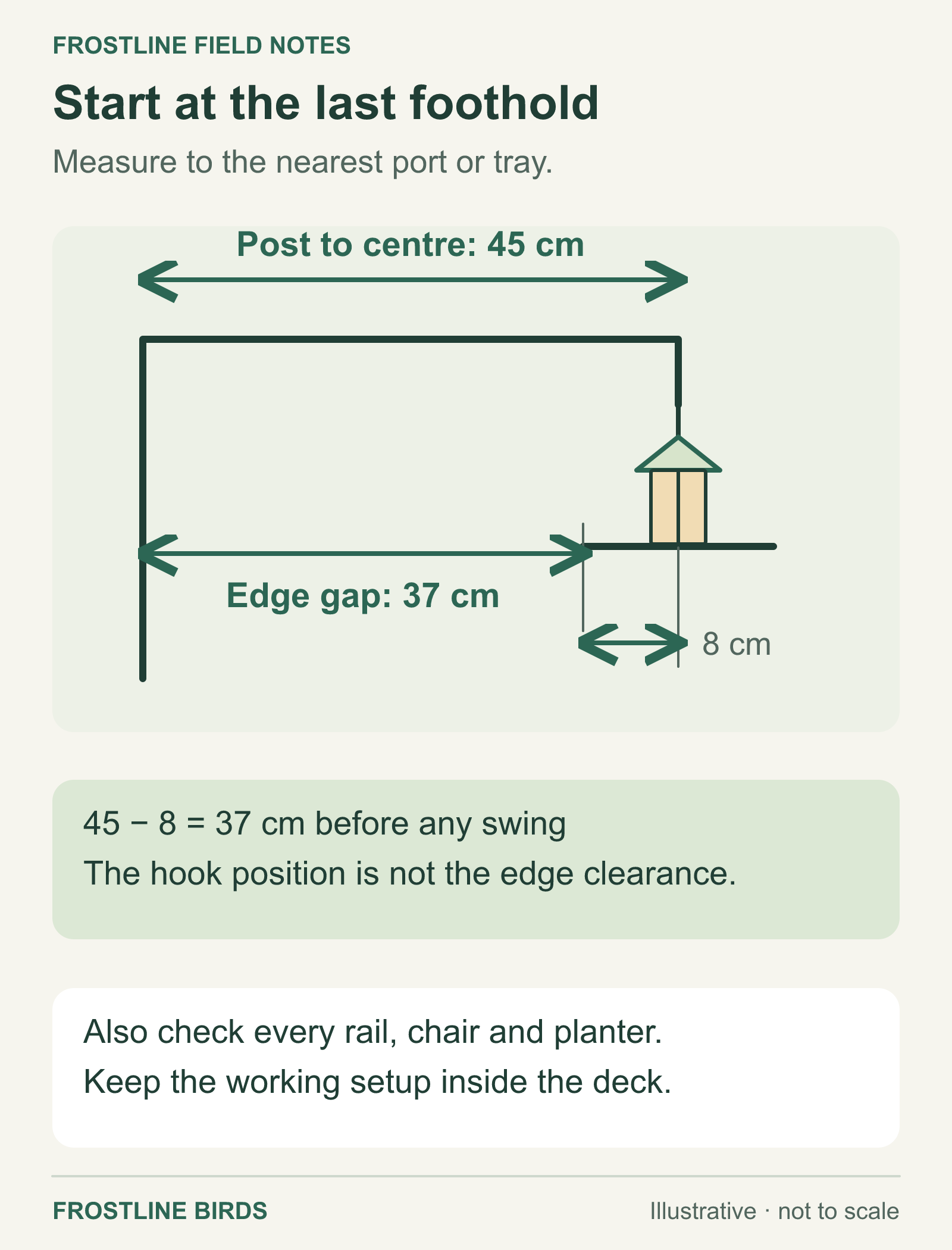
Brome gives roughly 18 in (about 46 cm) of clearance for its weight-activated approach because a squirrel supported by another surface may reach food without loading the closing mechanism. This requirement differs from the gap intended to discourage a free jump. A squirrel may land on a functioning feeder and still be unable to eat. For that design, judge performance by whether the ports close as intended, using only the maker’s approved settings and checks.
Match the observed route to the change
| Where the animal gets food | Change to try | What to verify on the next visit |
|---|---|---|
| At a port while standing on the rail | Move the unit to a compatible inboard position with adequate clearance | The animal cannot remain supported while feeding |
| From a broad catch tray | Remove or resize the tray only as the feeder allows, then clean the floor | The smaller tray has not simply shifted accessible food below |
| Through a cage from a nearby perch | Check port setback, cage fit and nearby footholds | Target birds can feed normally and wire remains undamaged |
| At the base after birds spill whole kernels | Correct food-to-port fit and reduce the served amount | The next refill produces fewer accessible whole seeds |
| From an opened lid | Restore the original latch or replace the damaged piece | The closure works and the feeder can still be opened for cleaning |
If you move a hook, keep the feeder, spilled food and removable parts over an area you control. Verify the rail profile and full load in the bracket instructions. An outward arm that puts the lid within reach of the next balcony is unsuitable even if its retail description uses the word “deck.” In a rental, confirm the exact permitted arrangement. The deck-rail setup guide covers siting for cleanup and safe removal.
A pole baffle is worth considering on a deck only if the pole is actually isolated from the rest of the structure and is installed in a compatible base. If the animal runs from the rail to a feeder above that baffle, a wider cone below it offers little benefit. The baffle bypass guide explains how to tell a climbing route from a sideways approach.
Keep the alternative suitable for the birds
A cage intended to admit small clinging or perching birds can exclude larger birds you wanted to watch. Check the manufacturer’s bird and food guidance and watch real access before declaring the change a success. If the only birds formerly using the station can no longer feed, a different location with the original feeder may better serve the yard. A weight mechanism also needs to move freely and remain clean around the ports. Ice or packed seed can interfere with movement.
Before rehanging a feeder with a moving shroud, use the inspection for squirrel-resistant feeder mechanisms to check for a jam, exposed wire or an improvised attachment.
Do not add loose netting, sticky coatings, sharp projections or homemade restraints to the rails. They can affect birds, pets and people using the same deck. Keep original latches and guards in place. Inspect after wind and after any forceful animal visit. A broken piece or bent cage belongs off the station until it can be repaired properly. Repeated damage by a larger animal calls for a different wildlife response from routine daytime squirrel visits.
Reduce the reward that remains on the deck
Use one measured portion and inspect where birds drop usable kernels as well as hulls. A feeder that stops a squirrel at the opening but supplies a pile along the skirting board still rewards visits. Sweep intact food before closing the deck for the evening. Clean soiled feeding surfaces and store the reserve supply in a secure location. An accessible refill bag behind a deck box can provide a much larger meal than the ports ever did.
After changing one feature, watch a few ordinary visits and write down the result. If one visiting squirrel now investigates and leaves but a nightly refill still disappears, check the nighttime feeder guide. If no arrangement gives sufficient clearance without encroaching on a stair or property below, evaluate a separate support in the yard. The space around a sound ground-level pole may allow both a clean feeding surface and an effective barrier.
For a deck that is used only in part of the year, take measurements with winter furniture put away as well as with it in place. The same installation may satisfy the feeder’s clearance guidance in one season and put a usable foothold immediately beside the port in another. Mark the positions of movable chairs or planters on the sketch so the household knows which change reopens the route.